
Reduced bubble retention
Recirculation helps carry bubbles out of the printhead flow path, reducing the risk of missing or broken lines caused by bubbles.
FHES PRODUCT SERIES 01 / SL
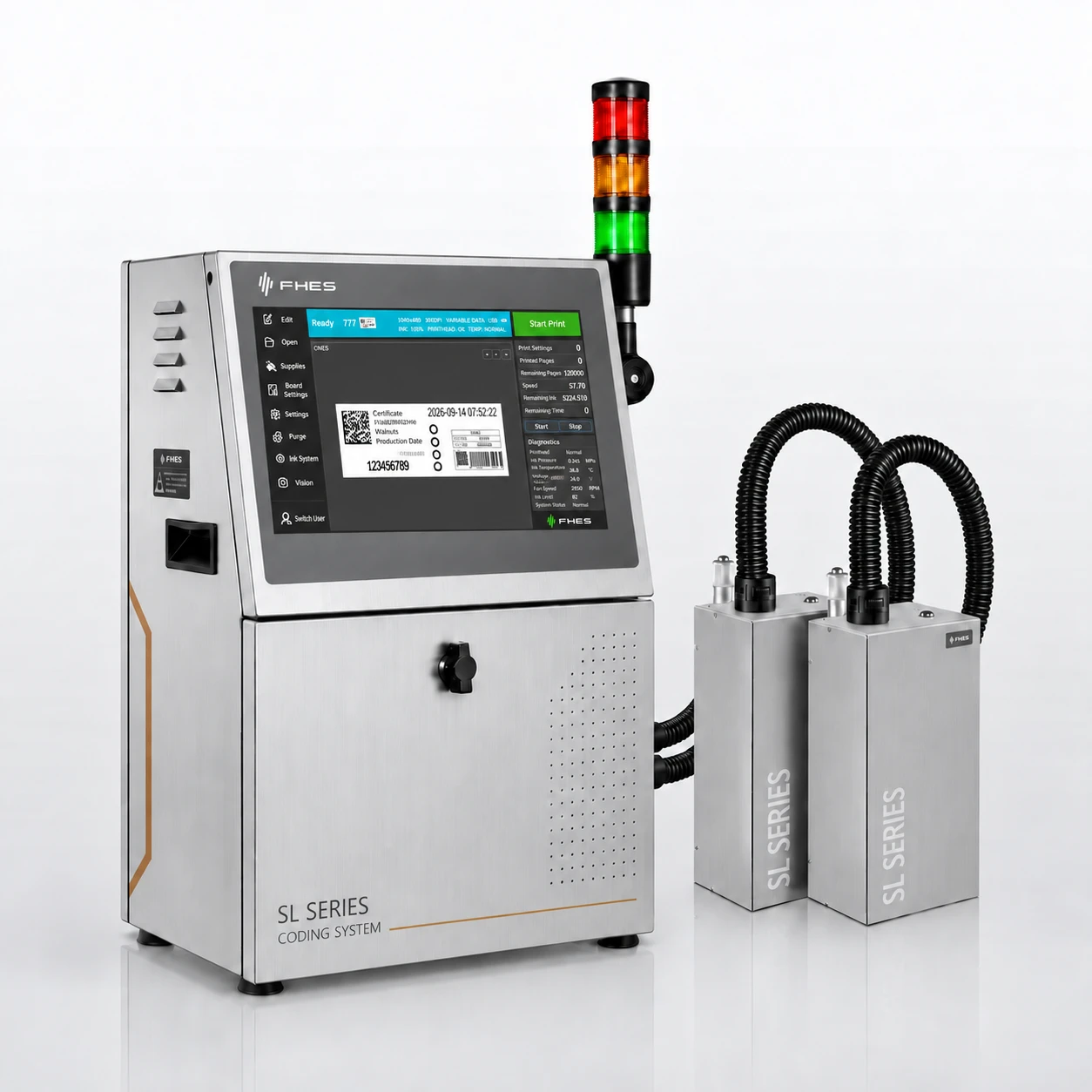
SL SERIES · Recirculating Printhead Printing System
The SL series combines recirculating printheads with the CCS recirculating ink supply system. Focusing on ink renewal inside the printhead, feed/return control and recovery after printing stops, it provides a verifiable printing solution for white ink and continuous production lines.
Specific ink, printhead configurations and printing results are subject to sample testing and the delivery plan.
01 / TECHNOLOGY
Ink supply, internal printhead recirculation and ink return form a continuous flow path. CCS manages feed/return status and target pressure differential to keep high-pigment-load ink flowing inside the printhead.
Recirculation helps carry bubbles out of the printhead flow path, reducing the risk of missing or broken lines caused by bubbles.
Increase ink renewal inside the printhead to reduce opportunities for dense pigments to settle in localized stagnant areas.
Keep nozzles ready to print, helping shorten preparation for next-day startup, shift changes or intermittent operation.
Continuous ink supply and bubble removal help maintain line continuity and reduce production interruptions caused by missing lines.
Recirculation paths and flow rates differ between printheads; these mechanisms do not mean maintenance-free operation for every ink and operating condition.
02 / CIRCLE CONTROL SYSTEM
Bring ink supply, recirculation, pressure feedback and maintenance management into one system to continuously renew ink inside the printhead and control feed/return status.
Monitor feed/return pressure and coordinate supply and return pumps to maintain the target pressure differential and nozzle negative-pressure operating window.
Manage replenishment according to ink level and monitor temperature; tank agitation helps reduce localized white-ink sedimentation.
The control board saves key parameters and reports them proactively, facilitating tracing of alarms, reconnections and recovery.
Provide entry points for ink priming, negative-pressure adjustment, draining, overflow handling and hardware testing according to configuration.
Ink level, temperature control, agitation, diagnostics and maintenance entry points depend on the actual SL machine configuration and delivery plan.
03 / WHITE INK IN PRACTICE
Dense white ink must do more than print: consider color and line condition after restart and during extended operation. In one site example recorded in the brochure, the machine stopped the previous day; recirculation was started the next day, and once the ink system stabilized, printing could begin without first purging ink or manually servicing the printhead.
This record applies to specific equipment, ink and site conditions; actual production still requires checks of nozzle condition and first-item quality.
Next-Day Restart · Suggested Procedure
Follow the required shutdown, recirculation and moisture-retention procedures
Confirm stable ink, temperature and pressure differential
Check first-item printing and nozzle condition
Begin continuous operation after meeting quality standards
04 / MODEL SELECTION
Select printhead modules according to print width, resolution, speed and printing distance. Data in the table below comes from the SL series V2.1 product brochure.
| Parameter | S1LCF6R | S2LRC1536 | S3LXaar 2002 | S4LG5F |
|---|---|---|---|---|
| Print Width | 54 mm | 108 mm | 70.5 mm | 54 mm |
| Native Resolution | 600 npi | 360 npi | 720 npi | 600 npi |
| Print Speed | 30 m/min | 157 m/min | 75 m/min | 76 m/min |
| Speed test conditions | 600 × 600 dpi | 360 × 360 dpi | 720 × 720 dpi | 600 × 600 dpi |
| Reference Throw Distance | 25 mm | 50 mm | 15 mm | 8 mm |
Speeds correspond to the listed resolution conditions; actual printing results depend on ink, materials and site operating conditions.
05 / APPLICATIONS
Recirculation provides a wider adjustment window for high pigment loads, frequent starts/stops and long print runs. Suitability still requires ink and sample validation.
For dark materials, transparent films, white underlayers and marking contrast requirements, validate opacity and adhesion first.
Barcodes, QR codes, UDI, batch numbers and database fields can be printed according to templates and production-line cycle time.
Configure the target ink volume according to the printhead, ink and waveform; high opacity or dimensional effects require evaluation together with curing.
For curved or stepped surfaces, test printing distance and placement first; reference throw distances differ between models.
06 / SYSTEM
Explore complete-machine SL series capabilities, from the operating platform and print content to ink-path maintenance and production-line interfaces.
Printhead modules, optional functions and actual delivery configurations depend on the project plan.
NEXT STEP / Sample Validation
Provide material samples, print content, target line speed, printing distance, ink color and shutdown duration. We can discuss configurations based on first-item quality, restart status and continuous-operation conditions.